When was the last time you were excited about investing in a car wash or a gas station?
Probably not recently. Yet in 2026, these two asset classes are drawing some of the most focused attention in commercial real estate. In our brokerage, demand hasn’t cooled. If anything, investors are approaching these deals with more intention and sharper underwriting than ever before. The renewed interest comes down to one powerful lever: 100% bonus depreciation and the urgency surrounding today’s tax environment.
Recent tax changes have allowed investors to accelerate depreciation on qualifying improvements, creating substantial first-year write-offs. Instead of spreading depreciation over decades, owners can front-load deductions and significantly reduce taxable income in year one. That’s not just a tax benefit; it’s a strategic tool. Imagine purchasing a $3 million car wash and, after a cost segregation study, identifying $2 million in assets eligible for accelerated depreciation. For investors in higher tax brackets, that can translate into hundreds of thousands of dollars in immediate tax savings. Those savings improve cash flow, enhance returns, and create capacity to reinvest or scale more aggressively. Sophisticated investors understand that tax strategy is inseparable from wealth strategy.
Why These Assets Work So Well
Car washes and gas stations are particularly well positioned for this environment because they are equipment-heavy assets. Fuel pumps, underground tanks, wash tunnels, vacuum systems, payment kiosks, lighting, and signage often qualify for accelerated treatment. A meaningful portion of the purchase price can be allocated to components that depreciate faster than the building itself. At the same time, these properties typically sit on prime real estate—hard corners, major intersections, and high-traffic retail corridors. The fundamentals still matter: visibility, accessibility, traffic counts, and strong demographics. These assets tend to check those boxes.
The model itself has evolved. The gas station of 2026 looks nothing like the one from decades past. We’re seeing automated payment systems, subscription-based car wash memberships, loyalty apps, data-driven pricing, expanded convenience retail, and even EV charging integration. That $45-per-month unlimited wash membership, multiplied across hundreds or thousands of subscribers, creates recurring revenue that stabilizes income and supports stronger valuations. The smartest operators are transforming what used to be transactional businesses into predictable, subscription-driven platforms.
What the Market Is Showing in 2026
Market activity reflects that shift. The car wash sector remains active, with continued consolidation and private equity involvement. Institutional capital rarely enters a space without seeing long-term scalability. On the fuel and convenience store side, transactions are more selective, but industry revenues remain solid. Investors are underwriting more carefully, paying attention to EV adoption, regulatory changes, and long-term fuel demand trends. That doesn’t eliminate opportunity; it simply raises the bar for disciplined analysis. Smart capital adapts rather than retreats.
The Rise of Hybrid Models
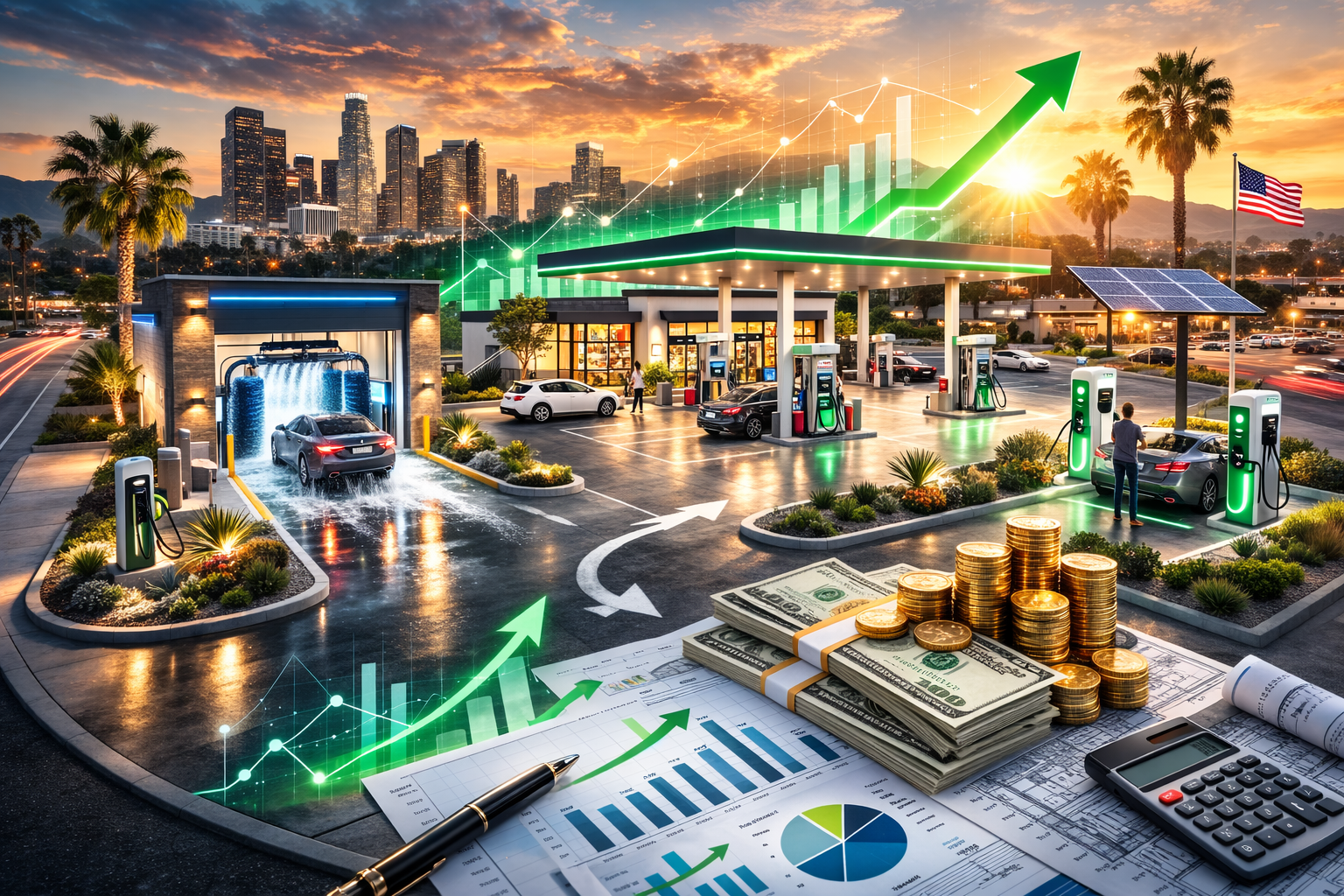
Another emerging trend in 2026 is the hybrid site. Investors are combining fuel operations, car washes, convenience retail, and EV charging infrastructure on a single parcel. Multiple revenue streams create layered income and help mitigate risk for both operators and landlords. Diversification within one property can build resilience, especially as consumer behavior and transportation patterns continue to evolve.
Here’s the Real Question You Need To Consider
The bigger question is how long the current tax advantages will remain in place. Tax policy is never permanent. Incentives phase in and phase out. Windows open—and they close. For investors who have been waiting on the sidelines, the current environment may represent a strategic entry point rather than something to observe indefinitely. Timing in commercial real estate isn’t about perfect predictions; it’s about recognizing favorable conditions and acting decisively.
Final Thought
In 2026, car washes and gas stations offer a combination of meaningful tax advantages, strong cash flow from essential-use businesses, well-located real estate, modernized revenue models, and creative hybrid opportunities. They may not be glamorous, but they are strategic. And sometimes the most powerful investments are the ones hiding in plain sight.
If you’re evaluating where to deploy capital next, look beyond cap rates alone. Consider tax positioning, operational scalability, and long-term adaptability. In this cycle, those factors may matter more than ever.
We also did a full video on this topic if you need more information.
Want more information on real estate investing? Subscribe to our newsletter or reach out via the contact page — we’re always sharing new ideas to sharpen your skills and grow your business.
